FREE Delivery
 No MINIMUM Spend
 Spend DISCOUNTS










































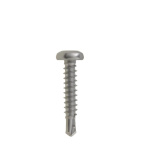











 Technical Charts & Calculators
 Orders
 Delivery
 Company Information
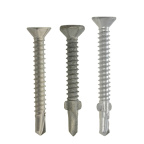
Issues with installing Self Drilling Metal Screws
The heads are breaking or the screw wont drive in: We get a call or email every month or so from often, a very frustrated customer, who is trying to fix something and the screws are not doing what they wanted them to do. By the time the contact us, they want to jam the screws down our....you know want..... and the last thing they want us to say is "99.999%" of the time its not the screw. But............unfortunately, it is either the way they are being installed or the material.
So how do we solve this?
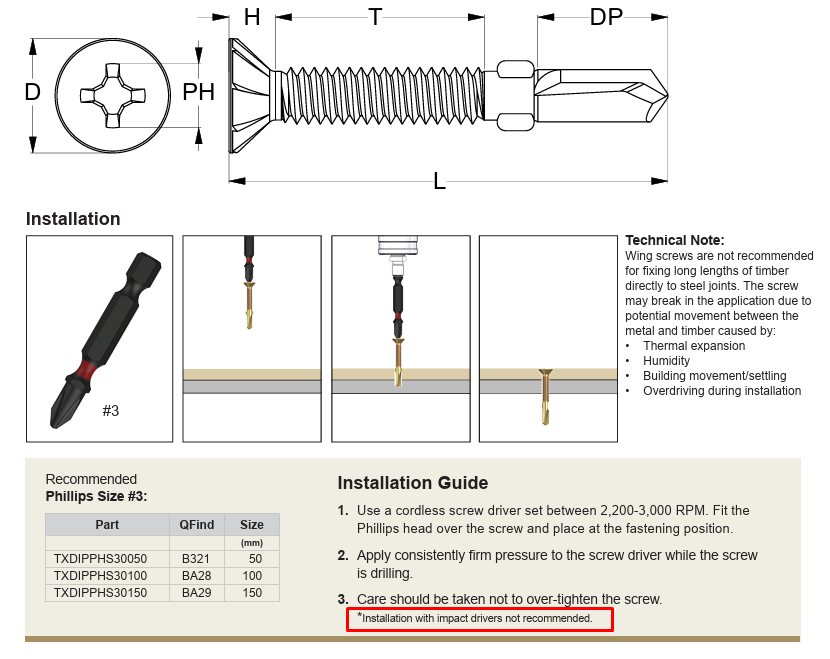
Screws have recommended installation torques. Each screw is different, but it’s usually around 1,000-2,500 RPM. When you go faster than that, the head will sometimes break or the drill point doesn't drill. That is not a fastener failure, but a user installation failure. "But I’ve always done it that way" is a common response.
We are all tuned to getting the job done quickly, but these days not all, but most, drills and i am referring to impact drills are super powerful and when installing screws the whole mindset is speed. The job needs to be done quickly and often Impact drivers are often TOO powerful for most self drillers.
This can be where the issues start.
Impact Driver vs Cordless Screwguns:
- Recommended drill speed into Steel Purlin is 2400 ' 2500 rpm MAX (Majority of Impact drivers are 3800 rpm!!!!!!)
- Recommended drill speed into Timber is 1500 rpm MAX
- By comparison a screwgun is max 2400 rpm and an Impact Drivers is 3800 rpm!!!!!!
- Impact drivers are not designed for self drilling screws, particularly into steel and can result in the following problems;
- Tips of self drilling screws are damaged resulting in burn-out or will not drill properly.
- Damaged or broken threads going into steel purlins, resulting in severely reduced holding power.
- Magnetic sockets will damage and remove paint from the head of the screw.
- Impact Drivers can crack or split the protective galvanised coating, resulting in premature corrosion of the screw.
- Fasteners can be overdriven particularly on pan fixed products, creating dishing around the fastener. Impact Drivers do not have a clutch or depth locator to reduce overdriving problems.
We are not saying you can't use an IMPACT, what we are saying is if you do, do so with caution and if problems do occur, try a drill driver.
Update 24th October 2025: Suppliers like Hobson are slowly adding data about the use of impact drivers to their technical pages, see below: